
From sunlight to mid‑infrared laser light
PhotoniX develops a new generation of solar‑powered Thulium‑doped fiber lasers that directly convert solar radiation into 2 µm laser emission, enabling efficient, compact, and energy‑autonomous photonic systems for terrestrial and space applications.
The project
A new generation of solar-pumped fiber lasers
PhotoniX develops a new class of solar-powered Thulium-doped fiber lasers that directly convert sunlight into coherent laser radiation at around 2 µm. The project addresses key challenges that have historically limited solar-pumped fiber lasers, including efficient coupling of sunlight into optical fibers, optimized excitation dynamics in rare-earth-doped fibers, and thermal stability under high solar irradiance. By combining expertise in solar optics, fiber technology, modelling, and laser systems, PhotoniX aims to demonstrate the first practical mid-infrared solar-pumped fiber laser platform.
Potential X-applications
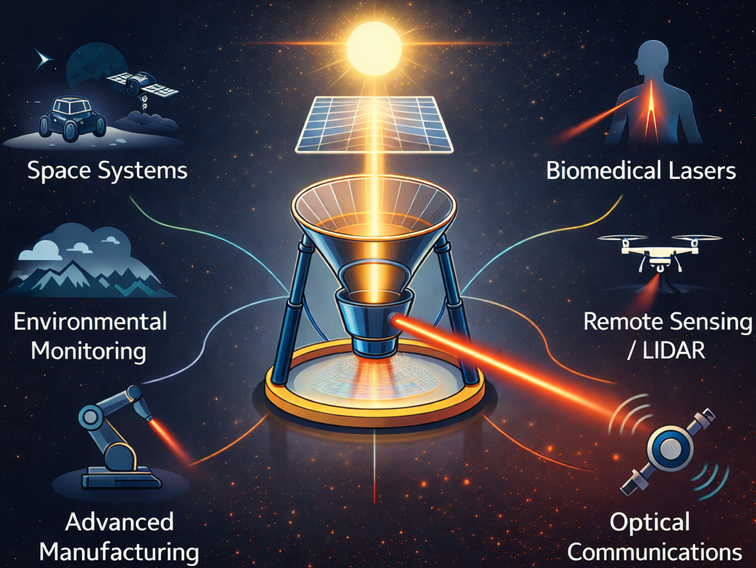
PhotoniX technology could enable a wide range of applications, including space systems and autonomous sensing, biomedical laser technologies, environmental monitoring, remote sensing and LIDAR, optical communications, and advanced laser-based manufacturing. By enabling direct solar-to-laser energy conversion, the project opens new possibilities for compact, energy-autonomous photonic platforms operating in remote, space, or energy-constrained environments.
Objectives
Core goals of PhotoniX
Goal No. 1
Adaptive Solar light Collection and fiber Injection
Develop a novel sun‑tracking solar concentrator system to efficiently inject incoherent sunlight into multimode optical fibers through side pumping.
Goal No. 2
Solar‑optimized Tm‑doped optical fibers
Design and fabricate advanced double‑ and triple‑clad thulium‑doped fibers capable of efficient solar pumping and operation under high thermal loads.
Goal No. 3
Digital twin of the technology
Develop an integrated optical‑thermal simulation platform capable of predicting the full system behaviour from sunlight collection to laser output.
Goal No. 4
First solar‑pumped mid‑IR fiber laser
Demonstrate the first continuous‑wave solar‑pumped fiber laser emitting at ~2 µm at TRL 4.
Technology
From sunlight collection to laser output
The concept integrates adaptive sunlight collection, optimized side-coupling into multimode fibers, advanced cladding architectures, and thermal stabilization strategies to support continuous-wave operation in the mid-infrared regime. The work is implemented in six Work Packages (WPs)
WP1
Project Management
Overall coordination, administrative management, reporting to the European Commission, and consortium coordination led by the Cyprus Institute.
WP2
Component and system level modelling and simulations
Development of multiphysics models describing optical, thermal, and laser dynamics to predict and optimize the SPFL system performance.
WP3
Adaptive Solar Collection and fiber injection system engineering and development
Development of a novel Adaptive Solar light Collection and fiber Injection system tailored for efficient side pumping of fiber laser spools
WP4
Fabrication and performance validation of Thulium-doped fibers
Design and fabrication of advanced thulium‑doped double- and triple-clad fibers optimized for solar pumping and thermal stability.
WP5
System integration, experimental validation and benchmarking
Integration and experimental validation of the complete PhotoniX system
WP6
Dissemination, Communication and Exploitation
Scientific dissemination, outreach activities, open science practices, and preparation of future innovation and commercialization pathways.
Partners
Consortium overview
The PhotoniX consortium brings together leading expertise in solar optics, fiber laser engineering, photonic component fabrication, and multiphysics modelling. The four partners jointly cover the entire innovation chain from theoretical modelling and optical design to fiber fabrication and full system demonstration at TRL 4.
The Cyprus Institute
Cyprus
Project Coordinator – Solar optics, Adaptive Solar light Collection and fiber Injection system development, system integration

Lumoscribe
Cyprus
SME partner – Femtosecond laser inscription, fiber Bragg gratings, system integration

Institute of Photonics and Electronics
Czech Republic
Fabrication of Tm‑doped fibers and laser component characterization

Karlsruhe Institute of Technology
Germany
Digital twin modelling, multiphysics simulations, SPFL modelling

4
Partners
3
Countries
2.3M€
Budget
36
Months of activity



PhotoniX is funded by the European Union’s Horizon Europe research and innovation programme through the European Innovation Council (EIC) Pathfinder programme under Grant Agreement No. 101258550.
Search